Journal / Styles
Interior design styles, explained in the bathroom
Words by the Bathroom Edit editor · Updated on 9 October 2026 · 14 min read
A style is a set of decisions about material, colour and line. The bathroom is where those decisions are hardest to fake, so here are eight styles explained through it, each with the spec board a designer would hand you.
Compare eight styles through their materials, colours and shapes. Each illustrated board is a starting point for a conversation with your designer, not a list of specified products or a waterproofing system.
Japandi
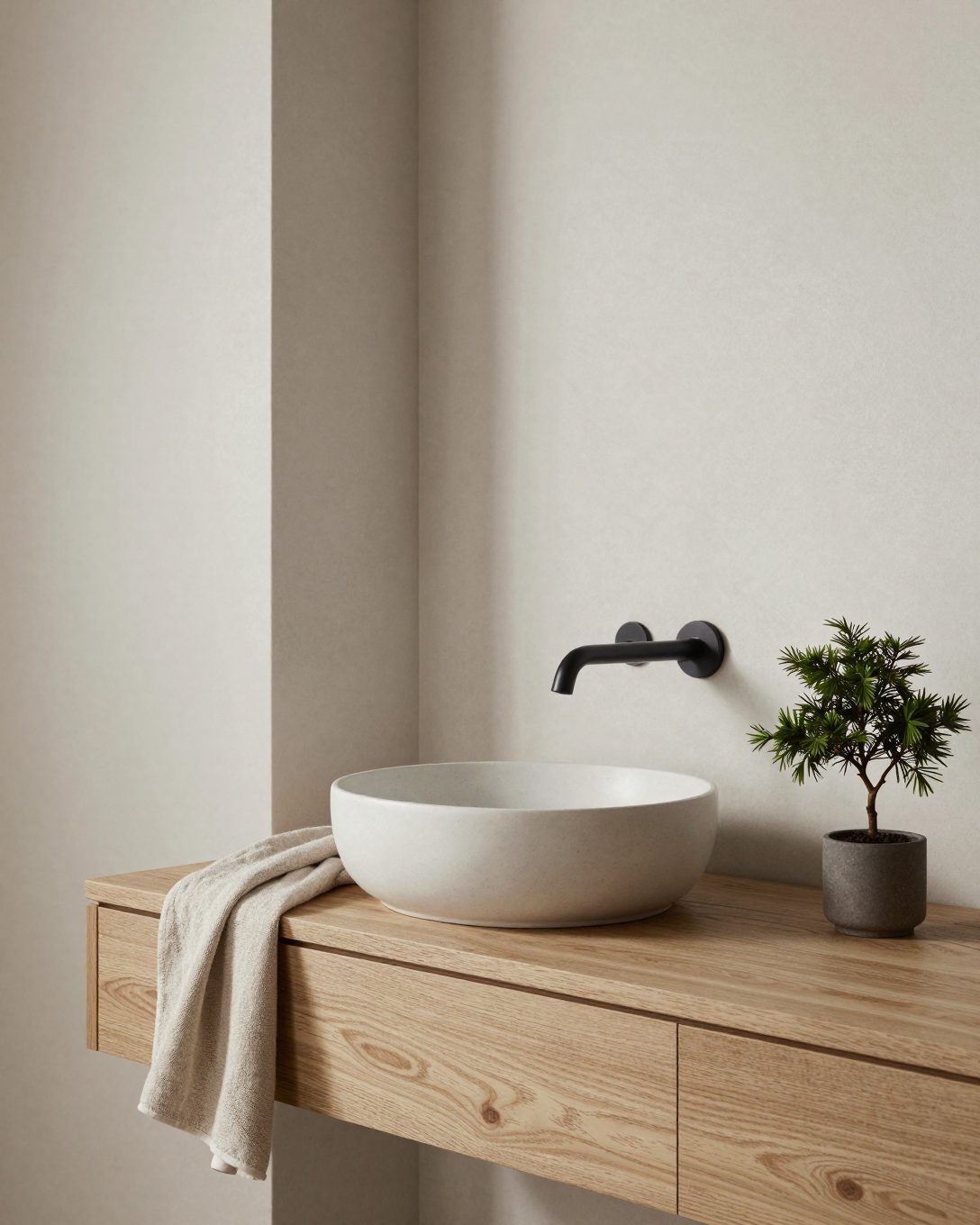
Spec board
- JoineryPale oak veneer
- BasinMatte white ceramic vessel
- WallsWarm white microcement
- TapwareMatte black
- TextileNatural linen
Japanese restraint meets Scandinavian warmth: light timber, matte surfaces, nothing on the bench. The Japandi bathroom in detail.
Contemporary

Spec board
- WallsLarge-format warm grey porcelain
- VanityFloating stone
- TapwareBrushed nickel
- ScreenFrameless glass
- FloorMatching porcelain
Big tiles, few grout lines and floating joinery. The current default for Australian renovations because it is calm and easy to clean.
Coastal

Spec board
- WallsWhite vertical lining boards
- VanitySage green
- FloorSandstone-look tile
- AccentWoven rattan
- TapwareBrushed brass
Light, textured and relaxed: painted timber lining, sea-glass greens and natural fibres, without nautical props.
Art Deco

Spec board
- WallsDeep green mosaic
- FloorBlack and white marble
- MirrorArched
- TapwarePolished brass
- DetailCurved edges
Geometry, glamour and colour, revived in older Australian flats and houses. One of the 2026 award winners is an Art Deco revival: see the trends.
Mid-century modern

Spec board
- VanityWalnut with tapered legs
- FloorTerrazzo
- WallsMustard finger tiles
- LightingOpal globe sconces
- TapwareChrome
1950s and 60s warmth: walnut, terrazzo, a bold tile and globe lights.
Hamptons

Spec board
- VanityWhite shaker with marble top
- FloorGrey and white marble
- TapwareChrome
- AccentNavy
- WallsCrisp white
American East Coast classic: white shaker joinery, marble and chrome, with navy as the accent.
Wabi-sabi

Spec board
- WallsLime plaster in clay tones
- BasinCarved stone
- TapwareAged brass
- FurnitureRough timber
- LightSoft and low
Imperfection on purpose: hand-finished plaster, natural stone and patina.
Maximalist

Spec board
- WallsBotanical wallpaper
- BasinPink scalloped
- MirrorGold frame
- FloorPatterned tile
- RuleOne room, all in
More is more, best tried in a small powder room: see powder room ideas.
How to find your style
Most people do not live in one pure style, and most good bathrooms borrow from two. Start by collecting photos of rooms you love, without thinking about style names. Then look for what they share: warm or cool colours, smooth or textured surfaces, curves or straight lines, lots of decoration or very little. Those shared features are your style, whatever its name. The names on this page are useful for searching and for talking to a designer, not rules to follow.
Japandi in more detail
Japandi blends Japanese calm with Scandinavian warmth: natural timber, stone and plaster, soft neutral colours, low and simple furniture, and very little decoration. In a bathroom, that means a timber or timber-look vanity, a large-format stone or plaster-look tile, a simple walk-in shower, matte tapware and hidden storage. See our full guide to the Japandi bathroom.
Contemporary in more detail
Contemporary simply means the style of now, and in Australian bathrooms it usually means clean lines, wall-hung fittings, large tiles with few grout lines, frameless glass and a restrained palette with one feature, such as a coloured tile wall or a statement mirror. It suits most homes and ages well because it avoids strong period references.
Coastal in more detail
Coastal bathrooms use light, airy colours, natural textures such as rattan, linen and timber, and blue, green or sandy accents. The best coastal rooms avoid obvious nautical decoration and rely on light, texture and a relaxed palette. Choose finishes that cope with humidity and salt air if you live near the beach.
Art Deco in more detail
Art Deco brings geometry, curves, bold colour and glamour: arched mirrors, fluted surfaces, terrazzo, brass, black and white tiles, and jewel colours such as emerald and deep blue. In a bathroom, a little goes a long way: an arched mirror, a fluted vanity or a patterned floor can carry the look without overwhelming a small room.
Mid-century modern in more detail
Mid-century bathrooms recall the 1950s to 1970s: warm timber, simple shapes, coloured tiles in mustard, olive or teal, terrazzo and globe lights. It suits homes from that era and owners who like warmth and a little nostalgia.
Hamptons in more detail
Hamptons style is classic and relaxed: white and navy, shaker-style cabinetry, marble or marble-look benchtops, subway tiles, polished nickel or chrome tapware and a freestanding bath where space allows. It suits large family homes and traditional architecture.
Wabi-sabi in more detail
Wabi-sabi finds beauty in imperfection: handmade tiles, raw plaster, irregular stone, earthy colours and objects that age with use. It is calmer and more textured than minimalism, and suits owners who like natural materials that wear in rather than wear out.
Maximalist in more detail
Maximalist bathrooms embrace pattern, colour and personality: bold wallpaper, patterned tiles, colour drenching, gallery walls and statement lighting. They work best in powder rooms and well-ventilated bathrooms, where moisture will not damage wallpaper and art. See powder room ideas.
Style and the building rules
Whatever style you choose, wet areas must be waterproofed to the National Construction Code and the Australian Standard, and electrical fittings near water must follow the wiring rules. Style decisions sit on top of those rules, not instead of them.
Mixing two styles
A Japandi and coastal mix, a contemporary room with Art Deco details, or a Hamptons bathroom with a mid-century light are all common. Keep the base calm and consistent, choose one style to lead, and let the second appear in two or three details.
Style by element: what changes from one look to the next
| Element | Japandi | Contemporary | Coastal | Art Deco | Hamptons |
|---|---|---|---|---|---|
| Vanity | Timber, simple | Wall-hung, flat-front | Light timber or white | Fluted or curved, dark | Shaker, painted |
| Tiles | Large, stone-look | Large, plain | Light, textured | Patterned, geometric | Subway, marble-look |
| Tapware | Matte black or brushed | Chrome or matte | Brushed nickel | Brass | Polished nickel |
| Mirror | Round, simple | Frameless or backlit | Rattan or timber frame | Arched | Framed, traditional |
| Colour | Warm neutrals | Neutral with one accent | Whites, blues, sand | Jewel tones, black | White and navy |
A table like this is a shortcut, not a rulebook. Most real bathrooms mix rows, and that is fine as long as the room has a clear lead style.
Contemporary versus modern
People often use the words interchangeably, but designers use them differently. Modern usually refers to the mid-twentieth-century movement: clean lines, honest materials and little ornament. Contemporary means whatever is current now, which in 2026 includes warmer timbers, softer curves and textured finishes. A contemporary bathroom today can include modernist ideas, but it also borrows from Japandi, Art Deco and other styles.
Industrial
Industrial bathrooms use concrete, exposed brick, black metal, subway tiles and utilitarian fittings, inspired by converted warehouses. In a bathroom, the look usually comes from a concrete-look tile or microcement, black-framed shower screens, exposed pipework tapware and a timber or steel vanity. Soften it with warm lighting and natural textures so it does not feel cold.
Scandinavian
Scandinavian bathrooms are light, simple and practical: white or pale walls, light timber, matte finishes and a few soft textiles. They are close to Japandi but usually brighter and with less emphasis on texture and earthy colour.
Mediterranean and desert modern
These styles draw on sun-baked architecture: textured limewash or plaster walls, terracotta and sand tones, arches, natural stone and handmade tiles. They suit warm climates and homes with good light, and pair well with brass and timber.
Traditional and Federation
Older Australian homes often suit traditional bathrooms: freestanding baths, pedestal basins, chequerboard or hexagon floor tiles, subway or decorative wall tiles, cross-handle tapware and panelled walls. A renovation can keep the period feel while adding modern waterproofing, storage and lighting.
Choosing a style for resale
If you plan to sell within a few years, a calm contemporary or soft Japandi base appeals to the most buyers, with personality added through paint, accessories and one feature. Strong period or maximalist schemes delight some buyers and put off others.
Style and maintenance
Some styles are easier to live with than others. Matte black tapware shows water marks on hard water; brass ages and changes colour; textured tiles and handmade zellige need more cleaning; real timber needs care in wet areas; and white grout shows dirt. If low maintenance matters, choose mid-tone tiles, brushed finishes and durable surfaces whatever the style.
Getting help
An interior designer can translate a style into a practical bathroom that suits your home, budget and the building rules. See what an interior designer does and what one costs.
Style examples in Australian homes
A Federation cottage in Sydney's inner west. A traditional bathroom fits the house: white subway tiles, a black and white hexagon floor, a freestanding bath, polished nickel cross-handle taps and a painted timber vanity. Modern waterproofing and a heated towel rail sit quietly behind the period look.
A 1960s brick house in Melbourne's suburbs. Mid-century modern suits it: a warm timber vanity, terrazzo or coloured square tiles, globe lights, and a nod to the original era in a mustard or olive accent.
A new coastal home in Queensland. Coastal contemporary: pale tiles with a subtle texture, a light timber vanity, brushed nickel tapware, a large walk-in shower and plenty of ventilation for humid summers.
An apartment in Perth. Contemporary with Japandi touches: large-format stone-look tiles, a wall-hung vanity, a backlit mirror, matte black tapware and hidden storage to keep a small space calm.
A country homestead in regional NSW. Hamptons or farmhouse: shaker cabinetry, a deep bath, marble-look tiles, brushed brass or nickel, and practical storage for a busy household.
How designers blend styles
Designers rarely use one style in its pure form. A common approach is to choose a calm base from one style, such as contemporary or Japandi, then add a few details from another, such as an Art Deco arched mirror, a mid-century light or a coastal rattan basket. Limiting the second style to two or three pieces keeps the room coherent.
Styles and budgets
Some styles cost more to do well. Art Deco and Hamptons often rely on detailed joinery, brass fittings and stone. Japandi and contemporary can be achieved on a modest budget with plain large tiles and a simple vanity. Maximalist rooms can be inexpensive if the drama comes from paint and wallpaper, or very expensive if it comes from stone and custom tiles.
Choosing a style with a partner
If two people disagree, look for shared ground in photos: you may both like warm timber, or both dislike glossy surfaces. Agree on the base first, then let each person choose one feature. A designer can help find a look you both like.
Japandi or wabi-sabi?
Both draw on Japanese ideas and natural materials, so they are often confused. Japandi is calm, refined and orderly: smooth timber, honed stone, clean lines and hidden storage, with a little Scandinavian brightness. Wabi-sabi is earthier and more imperfect: rough plaster, irregular handmade tiles, raw timber and objects that show their age. A Japandi bathroom feels like a quiet hotel; a wabi-sabi bathroom feels like a handmade retreat. Many bathrooms sit between the two, using Japandi's order with a few wabi-sabi textures.
Coastal or Hamptons?
Both are light and relaxed, but coastal is more casual and natural, with rattan, linen, pale timber and soft blues or sandy tones, while Hamptons is more polished and classic, with shaker cabinetry, crisp white and navy, marble-look surfaces and polished nickel. A beach house suits coastal; a large traditional family home suits Hamptons.
Art Deco or mid-century?
Art Deco, from the 1920s and 1930s, is glamorous and geometric: arches, fans, fluting, brass and rich colour. Mid-century modern, from the 1950s to 1970s, is warmer and simpler: organic shapes, timber, terrazzo and softer retro colours. Both suit homes from their eras and both can be suggested with a few pieces rather than a full period room.
Contemporary or minimalist?
Minimalism takes contemporary design to its extreme: almost nothing visible, every surface plain, every item hidden. It looks striking in photos but asks a lot of the people who live with it. Contemporary bathrooms are clean and simple but allow some texture, warmth and a few objects on display, which makes them easier to live in.
How to describe your style to a builder or designer
Instead of naming a style, describe what you want in plain words: warm or cool, smooth or textured, plain or patterned, light or dark, curved or straight. Add three photos you love and one you dislike, and say why. Builders and designers find this far more useful than a style label, because every label means something slightly different to different people.
Style and the size of the room
Some styles suit small rooms better than others. Contemporary, Japandi and Scandinavian rooms feel calm and larger because of their limited palettes and plain surfaces. Maximalist and traditional rooms can feel crowded in a small bathroom unless the pattern is used carefully, for example on the floor only or on one wall. In a large bathroom, almost any style works, and richer styles can stop a big room feeling empty.
Style for every room in the house
A bathroom does not have to match the rest of the house exactly, but it should feel related. Repeat a material, colour or detail from the main living areas, such as the same timber tone, the same tapware finish as the kitchen, or a colour from the living room, so the bathroom feels part of the home rather than a separate project.
Bathroom features by style
Baths: Japandi suits deep soaking tubs in simple shapes; contemporary suits slim freestanding baths; Hamptons and traditional suit roll-top or slipper baths; Art Deco suits baths with curved or fluted fronts; coastal suits simple white baths.
Basins: Japandi and wabi-sabi suit ceramic vessel basins; contemporary suits integrated or undermount basins; traditional suits pedestal or vanity basins; Art Deco suits round basins with brass taps; maximalist suits coloured or patterned basins.
Lighting: Japandi suits paper and timber pendants and soft strip lights; contemporary suits backlit mirrors; coastal suits rattan and glass; Art Deco suits fluted glass and brass wall lights; Hamptons suits classic sconces.
Hardware: Japandi suits slim recessed handles or push-to-open; contemporary suits minimal pulls; Hamptons suits cup pulls and knobs; Art Deco suits brass and curved handles; mid-century suits timber or slim metal pulls.
Knowing which features belong to which style makes shopping easier and keeps a room consistent.
Our short answer
The main interior design styles for Australian bathrooms are Japandi, contemporary, coastal, Art Deco, mid-century modern, Hamptons, wabi-sabi and maximalist, plus industrial, Scandinavian, Mediterranean and traditional. Choose by the house, the size of the room, how you want it to feel and how much care you are willing to give it.
How to test a style before committing
Before renovating, try a style in small ways: new towels, a mirror, a plant, a light fitting and a paint colour in the current bathroom. Live with it for a few weeks. If you still love it, carry it into the renovation; if not, you have changed your mind for the cost of a few accessories, not a whole bathroom. Many people find this the most reliable way to choose a style.
Styles and natural light
Styles look different depending on light. Dark, moody styles such as Art Deco and maximalist suit rooms with good daylight or used mostly at night; light styles such as coastal, Scandinavian and Japandi suit rooms with limited daylight because they reflect what light there is. Consider your bathroom's light before choosing a style that depends on brightness or on drama.
A quick style quiz
Answer these quickly. Do you prefer warm or cool colours? Smooth or textured surfaces? Curves or straight lines? Lots of objects on display, or almost none? Timber, stone or tiles as the main material? Brass, black or chrome? Warm, natural and few objects points to Japandi or wabi-sabi; cool, smooth and minimal to contemporary; light, natural and relaxed to coastal; curved, glamorous and colourful to Art Deco; warm, retro and organic to mid-century; classic and polished to Hamptons; bold and layered to maximalist. Most people land between two styles, which is a perfectly good place to be.
Styles that suit Australian climates
Australia's climates shape which styles work best. In humid Queensland and northern NSW, coastal, tropical and contemporary styles with good ventilation and moisture-resistant finishes suit. In dry, hot regions, Mediterranean and desert-modern styles with thick, cool-looking surfaces and earthy colours feel right. In cooler Melbourne, Hobart and Canberra, warmer styles such as Japandi, Art Deco and mid-century, with heated floors and warm timber, make bathrooms inviting through winter. Whatever the climate, ventilation and wet-area waterproofing come first.
When styles become clichés
Every style has its clichés: the anchor and rope in coastal rooms, the overdone gold in Art Deco, the empty white room in minimalism. Avoid them by choosing quality materials and subtle references rather than literal decorations. A coastal bathroom does not need seashells; it needs light, texture and an easy, breezy palette. A style works best when a visitor feels it rather than reads it.
Common questions
What are the main interior design styles?
The styles most used in Australian homes include contemporary, Japandi, coastal, Hamptons, mid-century modern, Art Deco, wabi-sabi and maximalist.
How do I find my interior design style?
Collect pictures of rooms you love and look for what repeats: the timber, the colour, the shapes. That pattern is your style, and a spec board is the way to write it down.