Journal / Ventilation
Bathroom exhaust fans: what the building code asks for, and how to choose one
Words by the Bathroom Edit editor · Updated on 8 October 2026 · 7 min read
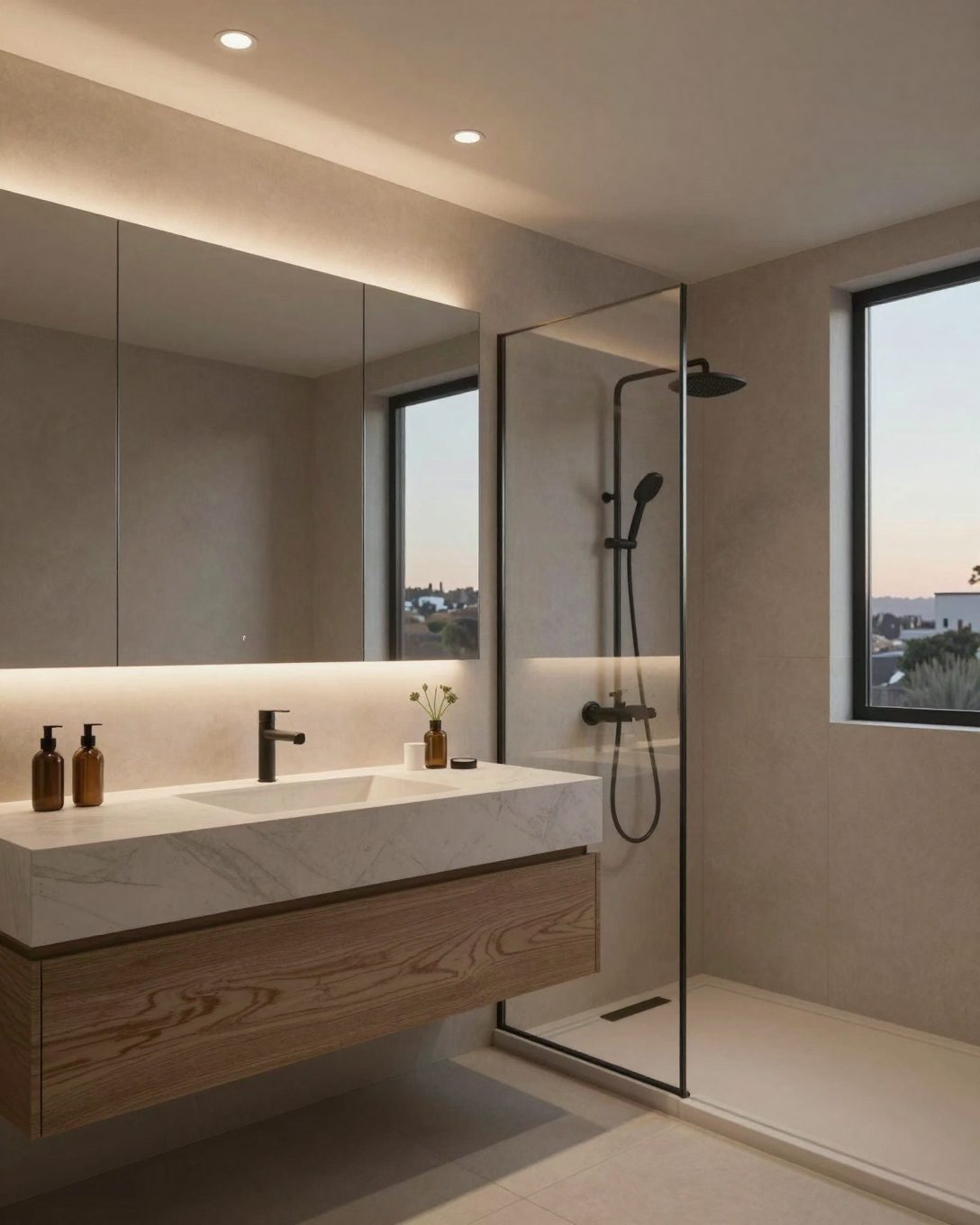
Under the National Construction Code 2022, a bathroom exhaust fan must move at least 25 litres of air a second and discharge to outdoor air through a duct or shaft, not into the roof space. In a bathroom without an openable window, it must switch on with the light and keep running for 10 minutes after the light goes off.
The National Construction Code 2022 sets the rules for exhaust fans in new homes and in work that must comply with it: a bathroom or toilet fan must extract at least 25 litres per second and discharge directly, or through a shaft or duct, to outdoor air. Venting into the roof space does not comply. In a bathroom with no natural ventilation, the fan must be interlocked with the light and run on for 10 minutes after the light is switched off.
The rules in one table
Clause 10.8.2 of the NCC 2022 Housing Provisions sets out a deemed-to-satisfy pathway for the housing classes it covers. This is not a universal specification for every building type or existing bathroom. NSW has announced adoption of NCC 2025 on 1 May 2027; ask the certifier which edition and pathway applies to your approval.
The main provisions:
| Requirement | Bathroom or toilet | Kitchen or laundry |
|---|---|---|
| Minimum exhaust flow | 25 L/s | 40 L/s |
| Where it must go | Directly, or via a shaft or duct, to outdoor air | Same |
| Into the roof space? | No | No |
| If the room has no compliant natural ventilation | For a fan not run continuously: interlocked with the light switch, with a 10-minute run-on timer | The bathroom/toilet interlock rule does not automatically apply |
| Make-up air if the room has no natural ventilation | Openings to an adjacent room with a free area of 14,000 mm², about a 20 mm undercut on a 700 mm wide door | Same |
These rules came in as part of the code's condensation management provisions, aimed at stopping warm, moist air from condensing inside roof spaces and walls, where it can cause mould and damage that nobody sees until it is advanced. Check with your builder or certifier how the code applies to your project.
Why ducting it outside matters
An old-style fan that blows into the ceiling moves the steam out of sight, not out of the house. In a cold roof space, that moisture condenses on the underside of the roof and on framing and insulation. The code's answer is a duct, run to a roof cowl, wall vent or eave vent, that takes the air all the way outside.
If you are renovating, ask the electrician and builder:
- Where will the duct run, and where does it come out?
- Is the fan rated for at least 25 L/s with the duct fitted? Long or flexible duct runs reduce a fan's real airflow.
- If the room has no window, is it interlocked with the light with a 10-minute run-on?
- Is there a gap under the door, or another opening, so air can get in to replace what the fan removes?
Choosing a fan
| Look at | Why |
|---|---|
| Airflow in L/s (or m³/h; divide by 3.6 for L/s) | Must meet 25 L/s in a bathroom, after duct losses |
| Noise in sones or dB(A) | Compare like with like between models |
| Ceiling, wall or inline type | Inline fans sit in the roof space with only a grille in the room; they still must be ducted outside |
| Backdraft shutter | Stops cold air and insects coming back down the duct |
| Light or heat combination units | Convenient, but check the exhaust rating is not compromised |
Electrical connection of a fan must be done by a licensed electrician.
Living with it
Run the fan during every shower and for a while afterwards. A bathroom that clears of steam quickly dries quickly too, which is the single best defence against mould on grout and ceilings. Our guides to wet room bathrooms and ensuite design cover the layouts where ventilation matters most: small, enclosed and often windowless.
Types of bathroom exhaust fan
Ceiling-mounted fans are the most common in Australian homes. They sit in the ceiling and duct air through the roof space to the outside.
Wall-mounted fans suit bathrooms on an external wall, venting straight outside through the wall.
Inline fans sit in the duct within the roof space, with a grille in the bathroom ceiling. They are quieter in the room and can draw from more than one grille.
Combination units combine a fan with heat lamps or a light, popular in cooler climates.
Sizing a fan
A fan is rated by how much air it moves, usually in litres per second or cubic metres per hour. Larger bathrooms, rooms with high ceilings and rooms with a steamy shower need more extraction. The building code sets minimums for new work; many owners choose a fan above the minimum so steam clears quickly. The length and bends of the duct reduce real airflow, so a fan with a long duct run needs more power than one venting directly outside.
Noise
Fan noise is rated in sones or decibels. A loud fan is often switched off early, which defeats its purpose, so a quieter fan is worth paying for, especially in ensuites. Inline fans are usually the quietest in the room.
Controls
A fan linked to the light switch runs whenever the light is on; adding a run-on timer keeps it going for some minutes after the light goes off, to clear remaining steam. Humidity-sensing fans switch on automatically when moisture rises. Separate switches give more control but are easy to forget.
Make-up air
A fan can only extract air if replacement air can get in. A small gap under the door or a door grille lets air flow into the bathroom as the fan runs. Without it, a fan works much less effectively.
Maintenance
Clean the grille every few months, because dust reduces airflow. Check the duct is still connected in the roof space if you notice the fan seems weaker, and listen for rattles that signal worn bearings. Replace a failed fan promptly, because a bathroom without working extraction will grow mould.
Exhaust fans and mould
Most bathroom mould problems come from moisture that is not removed. A properly sized fan, ducted outside, running during and after showers, is the most effective way to prevent mould. See mould in bathroom spaces.
Replacing an old fan
If an old fan is noisy, weak or vents into the roof space, replacing it is a small job with a big effect. A licensed electrician can swap a ceiling fan for a quieter, more powerful one and connect ducting to the outside, often in a single visit. Check the ceiling cut-out size, the duct size and the route to the eaves, roof or wall.
Our short answer
A bathroom exhaust fan should be sized for the room, ducted to the outside, quiet enough that you use it, and run during and after showers, ideally on a timer or humidity sensor. It is the single best defence against bathroom mould.
Fans for bathrooms without windows
Internal bathrooms with no window rely entirely on the exhaust fan, so choose one with more capacity and run it longer. A fan linked to the light with a run-on timer makes sure it runs after every use.
Exhaust fans and energy
Exhaust fans use little electricity, especially modern models with efficient motors. Running a fan for twenty minutes after a shower costs very little compared with the cost of repairing mould damage or repainting a ceiling. In winter, a fan does draw out some warm air, so a humidity-sensing fan that runs only as long as needed is a good balance between comfort and dryness. Fans with a backdraft damper stop cold air and insects coming back down the duct when the fan is off, which helps in cooler climates and older homes with draughty roof spaces.
Installing a fan
Exhaust fans must be installed by a licensed electrician, and the ducting run to the outside through a soffit, roof vent or wall. Keep the duct as short and straight as possible, insulated where it runs through cold roof spaces to reduce condensation, and sloped so any condensation drains outwards. Seal around the ceiling cut-out to stop moist air leaking into the roof space.
Signs your fan is not working well
Mirrors stay fogged long after a shower, the ceiling above the shower grows mould, paint peels, or a tissue held to the grille is barely pulled in. Any of these means the fan is too small, the duct is blocked or disconnected, or the fan is not running long enough. Check the grille, then ask an electrician to check the fan and duct.
Exhaust fans in laundries and toilets
Separate toilets and laundries also produce moisture and odours, and many need exhaust fans under the same building code principles as bathrooms. A laundry with a dryer especially benefits from extraction to the outside.